FSSAI crackdown pushes packaged-food brands to rethink claims, campaigns
FMCG players reassess product claims and review media mixes amid regulatory scrutiny; industry expects an impact on ad spends in the near term
 by
by
Published: Aug 31, 2026 8:40 AM | 7 min read
 Follow Us

- The Food Safety and Standards Authority of India (FSSAI) is intensifying efforts against misleading food claims, prompting packaged-food brands to reevaluate their product claims and marketing strategies ahead of the festive season.
- FSSAI has ordered several major FMCG companies to withdraw products with misleading "100%" claims, including honey and coconut oil, and has issued over 150 notices for non-compliance in advertising and labeling.
- The regulator is proposing front-of-pack warning labels for products high in saturated fat, sugar, or salt, which has faced opposition from major brands but support from consumer advocates and the Supreme Court.
- While FMCG companies are not expected to significantly cut advertising budgets, they may pause campaigns and shift focus towards more transparent and educational messaging in response to regulatory scrutiny.
The Food Safety and Standards Authority of India’s (FSSAI) stepped-up action against misleading claims and labelling non-compliance is prompting packaged-food brands to reassess product claims and communication strategies ahead of the festive season, ad executives say. While the industry does not expect a broad-based cut in FMCG media spending, some campaigns could be paused or budgets reallocated as brands respond to the heightened scrutiny.
Notably, the food regulator has directed several leading packaged-food companies, including some of India’s largest FMCG players and listed conglomerates, to withdraw food products carrying what it termed misleading “100%” claims and report the action within 15 days. The products include honey, apple cider vinegar, virgin coconut oil, sesame oil, cow ghee, coconut water and coconut milk. FSSAI said the products carried claims such as “100% Natural”, “100% Pure” and “100% Organic”.
The action is part of a wider crackdown. FSSAI has issued more than 150 notices to food companies, including ITC, Nestlé India, Dabur India, PepsiCo and Coca-Cola India, over misleading advertisements, false claims and labelling non-compliance. It has also pushed for clearer disclosures on salt, sugar and fat content and objected to claims such as “0% Maida”.
FSSAI is also proposing front-of-pack warning labels for packaged food and beverages. In a filing before the Supreme Court on Friday, it proposed a red hexagonal label for products high in any two or more of saturated fat, sugar or salt, Reuters reported.
The move could have a significant impact on food companies in India’s $100-billion-plus packaged-food market. Coca-Cola and industry groups representing Nestlé and PepsiCo have opposed such labels, arguing that they could confuse consumers, while activists and the Supreme Court have backed stronger front-of-pack warnings, citing concerns such as obesity.
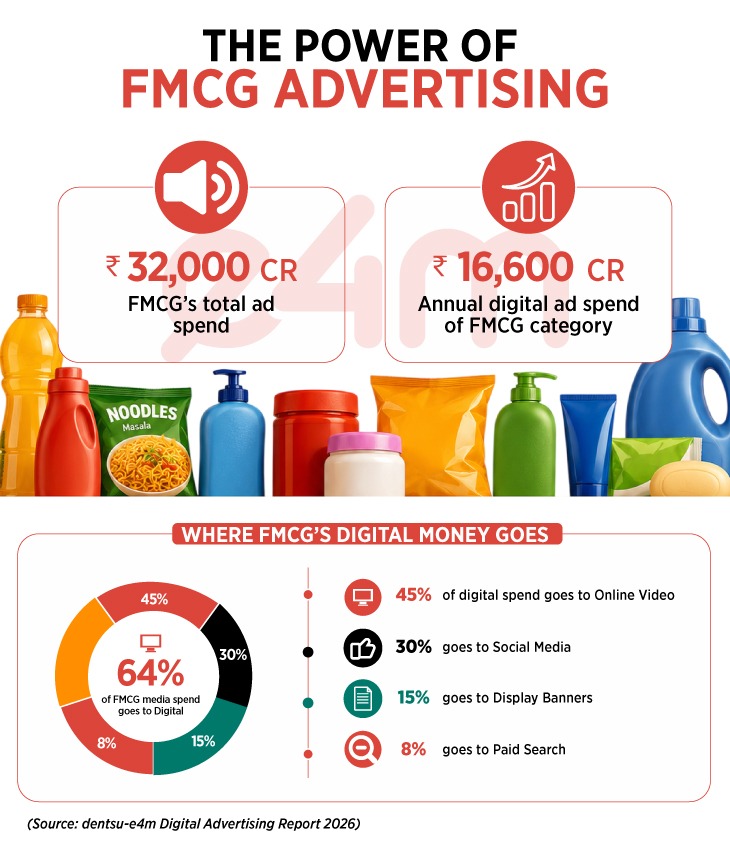
The companies under scrutiny include some of India’s biggest advertisers, with annual ad spends of ₹500 crore or more. Overall, FMCG companies account for nearly one-third of India’s advertising market, which crossed ₹1.25 lakh crore in 2025. Around 65% of FMCG marketing budgets are allocated to digital channels, according to a dentsu report.
The heightened scrutiny comes at a critical time for the packaged-food industry, with brands gearing up for the festive season, traditionally one of the strongest periods for consumer spending and advertising. Most players have been steadily increasing their media spends over the past few quarters and had planned higher allocations for the festive quarter. However, the regulatory uncertainty could put some pressure on growth and discretionary spends, industry experts said.
For the advertising and media industry, the immediate question is whether the regulatory action will lead to a broader reassessment of media budgets or primarily change how products are positioned and communicated. Several brands that have so far remained outside the regulatory action are also reviewing their campaign and packaging strategies to avoid potential compliance issues.
Also Read: FMCG giants turn up advertising heat as competition intensifies
e4m reached out to FMCG advertisers, who declined to comment on the record, citing the matter as sub judice. However, informally, some said they are reviewing their media spends and communication strategies as they navigate the evolving regulatory environment and seek to maintain consumer trust.
“Given the current uncertainty, some advertising spends are likely to be held back. The bigger shift could be in messaging, with greater emphasis on substantiated claims, product transparency and consumer education. We are certainly reviewing our communication plans. At this stage, it is not about just cutting advertising spends, but about being more careful about what we say, where we say it and how we substantiate our claims,” said a marketer associated with a leading FMCG player.
Another senior marketer said “While we are not looking at any significant reduction in overall advertising spends at this stage, some campaigns may have to be paused. Besides, we will have to wait for the SC verdict, which may guide us further on the next steps on labelling.”
“If it rules in favour of hexagonal red warnings on the front of packs, we need to allocate funds for new packaging and perhaps withdraw the old stock. Our strategy depends on the court ruling,” the marketer said. “The entire industry, not just affected companies, is anxiously awaiting the court’s direction in this regard.”
‘Most brands are revisiting claims and labels suo motu’
Dr Sandeep Goyal, MD, Rediffusion, believes the impact is likely to remain limited to brands directly affected by the regulatory action for now. However, he says most brands are reviewing their claims and labels voluntarily.
“There is some turmoil on account of FSSAI, but it is not enough to recast plans or reassess media across the board, except for those brands directly under fire. Most brands are revisiting claims and labels suo motu, in consultation with their legal teams and R&D. That could have a more long-term impact, but it is still early days.”
The shift could also extend to communication channels. With brands facing greater scrutiny around product claims, some advertising executives expect greater use of influencer-led, contextual and education-led communication, particularly when introducing reformulated products or new packaging.
Anil Solanki, Media Lead, dentsuX, also does not expect the regulatory scrutiny to trigger major cuts in CPG advertising.
“The regulatory scrutiny is unlikely to trigger major cuts in CPG ad spends, but it will make brands more cautious about product claims and messaging. We could see greater emphasis on transparency, ingredient-led communication and healthier portfolios, while media budgets remain largely intact but shift towards more contextual and education-led campaigns.”
The category’s digital-heavy media mix could provide brands with greater flexibility to adapt communication. With 64% of FMCG media spend going to digital, online video accounts for 45% of digital spends and social media another 30%, together making up nearly three-fourths of digital budgets. Display banners account for 15%, while paid search takes 8%, according to the dentsu-e4m report.
This mix could allow brands to modify messaging and product communication across digital touchpoints more quickly, particularly as they respond to regulatory developments. However, whether this translates into a meaningful reallocation of media budgets remains to be seen.
Shradha Agarwal, Co-Founder and CEO of Grapes, takes a different view. She says, “Whenever these laws come in, they don’t really have an impact on marketing. The conversations happen on the side, while marketing continues in the same direction. Brands do, however, respond if they are highlighted and the news goes viral. That’s when they may ramp up their influencer marketing, immediately change the packaging or choose to advertise a little more. But I’m not seeing significant changes in marketing unless it becomes a big gimmick.”
A growing industry
The regulatory scrutiny comes against the backdrop of continued expansion in India's packaged-food market. According to IMARC Group estimates, the market grew from US$129 billion (approximately ₹10.8 lakh crore) in 2025 to US$137 billion (approximately ₹11.5 lakh crore) in 2026 and is projected to reach US$238 billion (approximately ₹20 lakh crore) by 2034, registering a CAGR of 6.24% between 2026 and 2034.
Rising disposable incomes, urbanisation, the expansion of modern retail and quick commerce, and growing demand for convenience-led food products are among the factors driving the market.
The expansion has also encouraged FMCG companies to build portfolios around healthy, natural and organic foods, targeting younger consumers who are increasingly conscious of ingredients and nutritional content. At the same time, convenience-led food consumption continues to grow.
The regulatory action, however, could eventually have implications beyond packaged-food brands, with industry observers warning of a potential cascading effect on the advertising and media ecosystem.
Read more news about Marketing News, Advertising News, PR and Corporate Communication News, Digital News, People Movement News
For more updates, be socially connected with us onInstagram, LinkedIn, Twitter, Facebook, YouTube & Google News